Wednesday, 7 June 2006

Pyramids in Bosnia

One of many, many joys of living in the Balkans: sensational archaeological discoveries (not sure which one of these three words to put under inverted commas).


UNESCO Team to Probe Bosnian "Pyramid"
Reuters
SARAJEVO (June 5) - Bosnia's mystery pyramid will now be probed and inspected by a team of experts from the U.N. Educational, Scientific and Cultural Organization.


"We shall send a UNESCO expert team to Visoko to determine exactly what it is all about," UNESCO Secretary General Koichiro Matsuura said in an interview published on Monday in Dnevni Avaz newspaper.


Amateur archaeologist Semir Osmanagic has caused a stir with his find, although local and European archaeologists denounce it as nonsense.


Geologist Aly Abd Barakat, an Egyptian researcher sent by Cairo to assist Osmanagic's team last month, has said that the Visocica hill did appear to be a primitive man-made pyramid of uncertain age.


Barakat said huge stone blocks found on the three sides of the hill used the same type of artificial cement used in ancient Egyptian pyramids.


Osmanagic's team is also investigating the Pljesevica hill -- which he calls the Moon Pyramid -- as well as underground tunnels he believes connect three pyramids.
The researchers have also found a sandstone monolith in the underground tunnel with enigmatic symbols engraved on it, which will be sent to Egypt for analysis.


Osmanagic, who studied pyramids in central America for the past 15 years, said that satellite and radar analyses have revealed the perfect geometry of Visocica and precise alignment of its sides with four cardinal points.
It does resemble a pyramid:
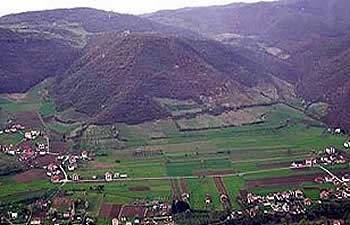
Photo: www.superbosna.com

Sunday, 4 June 2006

Yucca will show them

For some inexplicable reason, none of the plants I've ever bought managed to stay alive for more than a few weeks. Sadness descends upon me whenever I remember a cute little bonsai I bought two years ago. I saw it in a garden centre and just had to have it. Within two weeks all of its tiny, dark green leaves turned brown. Another two weeks and all that was left of it was its miniature, leafless trunk. I thought it was going through a mini-autumn season of its own, supposing that bonsai trees, minuscule as they are, must have a different notion of time. Much like cats or dogs. I expected it to enter a verdant spring of its own in no time. It never recovered though. I've kept the poor tree as a decoration of some sort (it does look quite nice, although a bit morbid, lifeless and denuded as it is). It now also serves as a caveat, reminding me to think twice before I buy a plant I know nothing about. I've been keeping that rule ever since.

Until yesterday, that is. I dragged a friend with me to that same garden centre, as a safeguard against impulsive shopping. The same friend who not only encouraged me to buy that bonsai two years ago, but also got one for himself (similarly unfortunate, as time would show). To cut a long story short, meet two new additions to my home: Yucca and Pachira. Described as low-maintenance plants, tolerating all sorts of conditions and asking for only a little bit of sunlight and water (TLC goes without saying), they seemed just perfect. I keep gazing at them as I write, checking obsessively for any sign of malaise or discontent. I've decided that these two are to prove everyone (myself included) wrong in thinking that I have a lethal effect on plants, as some have implied. I'm prepared to do anything it takes for them to live a long and healthy life. And if they survive until spring, I may even feel encouraged to do some serious container gardening next year. Fingers crossed!

Thursday, 27 April 2006

Yoga troubleshooter wanted

I was having really great time doing yoga this morning. Everything went just fine, I was centered and in sync with my inner self and all that - until I attempted to do this one:


A yoga torture posture from hell, as far as I'm concerned. I couldn't possibly lift my legs, head and chest simultaneously if my life depended on it.

This is what my handbook says about this asana: "The solar plexus area is revitalised and the massaging and stretching of the abdominal area relieves the sensations of anxiety we sometimes feel in the abdomen. [...] Toxins and tension are released from the organs helping them to work more effectively."

Well, those nasty toxins seem to have gone straight to my head, because I feel totally frustrated about not being able to pull it off, after months of practise. I know yoga is all about patience and slow progress, but for the love of...

Tuesday, 25 April 2006

This guy can't be an evangelical!

"An evangelical Virginia farmer says a revolution against industrial agriculture is just down the road. [...]

"Joel, who describes himself as a “Christian-libertarian-environmentalist-lunatic farmer,” speaks of his farming as his “ministry,” and certainly his 1,000 or so regular customers hear plenty of preaching. Each spring he sends out a long, feisty, single-spaced letter that could convince even a fast-food junkie that buying a pastured broiler from Polyface Farm qualifies as an act of social, environmental, nutritional, and political redemption."

READ THE REST OF THE ARTICLE AT MOTHER JONES:
http://www.motherjones.com/news/feature/2006/05/no_bar_code.html

Wednesday, 5 April 2006

Dalmatia Revisited

Adriatic coast of Croatia has become popular again, after the civil war and unrest of the 1990s. Its  beaches, islands and delightful towns testify to the truthfulness of the Croatian Tourist Board’s official motto: “The Mediterranean as it once was.” It didn’t take me much persuading to pay a visit, for the first time since the late 1980s.

I decided to travel by bus, for a number of reasons. The bus fare was quite cheap and so a great saver. Since the roads in Croatia are well maintained, the twelve-hour journey from Belgrade didn’t seem so long or tiresome at all. Each stop along the way proved to be a small adventure in itself, showing that Croatia’s rich cultural diversity doesn’t all come down to familiar, as-seen-on-TV, sights of Dubrovnik.

I left Belgrade on a hot July afternoon, reaching Serbian-Croatian border by midnight, amid old, tall trees of Sipovacka Forest of the country's continental, northeastern region. Several hours later, having quickly passed by Zagreb, the nation’s capital, we reached Lika, the region connecting continental and maritime parts of the country. Another short stop in one of its small towns, amidst white karst and cool air smelling of mountain herbs – and sheep! Adorably rustic.

After two more hours of wonderful scenery I got off the bus to Split, in the middle of Dalmatian nowhere. Below me, down the rocky hills, the so-called Karin Sea - actually a small bay of sorts, situated not far from Dalmatia’s highest mountain, Velebit. An unlikely tourist destination, with population of only several hundred (climbing up to several thousand during summer months). Karin certainly has its treasures: pristine nature, fine local wines, medieval Franciscan cloister and ancient monuments along the roads, dedicated to local pagan deities of many centuries ago.

Off the beaten path, it’s a Mediterranean pastoral idyll if there ever was one.

Wednesday, 15 March 2006

Quarterly Book Reviews #1

With spring beginning in just a few days, I thought it would be nice to make a seasonal review of some of the books that I read during the winter. Here are the ones I found particularly interesting and which I can heartily recommend.

PSYCHOLOGY/BIOGRAPHY

Inside the Mind of Joseph Smith: Psychobiography and the Book of Mormon by Robert D. Anderson (Signature Books 1999)

Another attempt to shed some light on the origins of the Book of Mormon. An impressive psychological profile of one of the most interesting and controversial religious visionaries of the 19th century. Enlightening when it comes to Joseph Smith's family background and the early childhood, far-fetched (although still fascinating) regarding the actual Book of Mormon = psychobiography hypothesis.


AUTOBIOGRAPHY

Before I Say Goodbye by Ruth Picardie (Penguin Books 1998)

Collection of articles, selected emails and letters written by an incredibly witty woman documenting her struggle with cancer and dealing with imminent death. Both hilarious and heartbreaking. One can only hope it will never be turned into a cheesy film.


RELIGION/MYTHOLOGY

On Having No Head: Zen and the Rediscovery of the Obvious by D. E. Harding (Penguin Arkana 1986)

Appropriately brief and concise given the topic (80 plus pages). Greater part of the book is the author's description of the experience of "headlessness" (with techniques on how to get there). Nicely written, beginner-friendly.

P.S. Makes one wonder about the whole concept of writing or reading books on Nothing...


CULTURAL PORTRAIT

The Book of Tea by Kakuzo Okakura

Short history and description of the Japanese tea ceremony, its significance in Zen culture, art and aesthetics, interspersed with the author's subtle nostalgia for Japan as it once was. Absolutely delightful.


RELIGION/MYTHOLOGY

The Spiral Dance: A Rebirth of the Ancient Religion of the Goddess by Starhawk (HarperSanFrancisco 1999) 

First published in 1979, it's a seminal book that continues to have a profound influence on the neo-pagan movement and feminist thealogy (that's right, thealogy). Although a Wiccan classic par excellence, it should appeal to religious progressives across the board, irrespective of gender, race or creed.

Sunday, 5 March 2006

Taking Leave of God

I've always thought of myself as a religious person. I've been going to church services regularly for most of my life, reading the Scriptures, thinking about theological issues (rather obsessively at times), teaching Sunday School, volunteering... To cut a long story short, I was a devout Christian. Although there has always been a liberal twist to my faith, I never thought I would come to a point where I would question the fundamentals of my entire belief system. And yet, it did happen.

My "prayer life" was first to disintegrate. It worked fine up until my late teens, but by my mid-20s I realized I didn't really have any clue as to who or what I was praying to, nor why I should be doing it. The concept of Heavenly Father continued to make sense for some more time to come, until it eventually collapsed, leaving behind traces of an inherently ill structure based on emotional void and fear. It finally dawned on me: somewhere along the way I had mistaken neurosis for religion. And so rather than picking up the pieces and moving on, I simply moved on. Ran away, to be more precise, as fast as I could. About two months ago, talking to a close friend, I managed to utter that dreaded word - atheist - applying it for the first time to myself, if only to see how it would sound. Nothing spectacular happened. It didn't hurt a bit. The earth didn't quake. I soon realised it's really not a word I could fully apply to myself, but that's a different story.

All of this is to serve as an introduction to a book that has helped me understand and deal with what I've been going through, religionwise. It's "Taking Leave of God" by Don Cupitt, first published in 1980 by SCM Press. While some of the chapters might be too philosophical and somewhat difficult to process, it's a very exciting book, dubbed by some a manifesto of "Christian Buddhism". Drawing inspiration from religious thinkers and philosophers as diverse as Tertullian, Meister Eckhart and Kierkegaard (to mention but a few), Cupitt attempts to establish a new (or renewed?) and almost Zen-like paradigm of Christian religiosity. Warmly recommended.