I've returned from my three-week summer holidays in Croatia, my pays d'origine. I already miss its ancient cities, islands, the sea and the warm, unpredictable Mediterranean wind and, last but not least, its shopping malls (Croatian Tourist Authority really should pay me for heaping praises like that). I'll be travelling there again relatively soon, so I'm not too depressed about coming back home.
If I'm not too lazy I might post an extract or two from my journal later on. On second thought, who would want to read about me sunbathing, snorkeling and collecting pebbles and sea shells, going shopping five times a day (as a hobby) and maniacally doing crosswords in between, day after day?
P.S. A warm welcome (and come again) to everyone who visited the blog while I was away. And I've checked, there were quite a few hits!
Sunday, 6 August 2006

Wednesday, 21 June 2006
Celebrate Summer
One of the things I have picked up along my spiritual path so far is the celebration of the ancient sacred days. While most people would identify them with (neo)pagan beliefs and practices, the fact is that all the major Christian holidays were originally pagan days of observance, clothed in Christian imagery during the first several centuries of the Common Era. Christianization of these holidays was supposed to show the all-encompassing superiority of the Christian creed, while heavily relying on pagan symbolism, rites and archetypes.
Going back to the authentic, Earth-based, meaning of these holidays, observing the cycle of the year and devising my own ways to honour it, gave a whole new quality to my spirituality, making it more positive, creative and less dependent on any particular religious or Church teaching. At the same time, it recognizes the Divine - however one might experience it - in the workings of Nature.
Tomorrow happens to be one of the most important solar holidays, the Summer Solstice or Midsummer. If you want some facts and information about Midsummer celebrations in various cultures (both ancient and modern) and their rich symbolism, Religious Tolerance, Beliefnet, and BBC are great places to start.
Happy Summer Solstice and have a great summer!
Going back to the authentic, Earth-based, meaning of these holidays, observing the cycle of the year and devising my own ways to honour it, gave a whole new quality to my spirituality, making it more positive, creative and less dependent on any particular religious or Church teaching. At the same time, it recognizes the Divine - however one might experience it - in the workings of Nature.
Tomorrow happens to be one of the most important solar holidays, the Summer Solstice or Midsummer. If you want some facts and information about Midsummer celebrations in various cultures (both ancient and modern) and their rich symbolism, Religious Tolerance, Beliefnet, and BBC are great places to start.
Happy Summer Solstice and have a great summer!
Wednesday, 7 June 2006
Pyramids in Bosnia
One of many, many joys of living in the Balkans: sensational archaeological discoveries (not sure which one of these three words to put under inverted commas).
UNESCO Team to Probe Bosnian "Pyramid"
Reuters
SARAJEVO (June 5) - Bosnia's mystery pyramid will now be probed and inspected by a team of experts from the U.N. Educational, Scientific and Cultural Organization.
"We shall send a UNESCO expert team to Visoko to determine exactly what it is all about," UNESCO Secretary General Koichiro Matsuura said in an interview published on Monday in Dnevni Avaz newspaper.
Amateur archaeologist Semir Osmanagic has caused a stir with his find, although local and European archaeologists denounce it as nonsense.
Geologist Aly Abd Barakat, an Egyptian researcher sent by Cairo to assist Osmanagic's team last month, has said that the Visocica hill did appear to be a primitive man-made pyramid of uncertain age.
Barakat said huge stone blocks found on the three sides of the hill used the same type of artificial cement used in ancient Egyptian pyramids.
Osmanagic's team is also investigating the Pljesevica hill -- which he calls the Moon Pyramid -- as well as underground tunnels he believes connect three pyramids.
The researchers have also found a sandstone monolith in the underground tunnel with enigmatic symbols engraved on it, which will be sent to Egypt for analysis.
Osmanagic, who studied pyramids in central America for the past 15 years, said that satellite and radar analyses have revealed the perfect geometry of Visocica and precise alignment of its sides with four cardinal points.
It does resemble a pyramid:
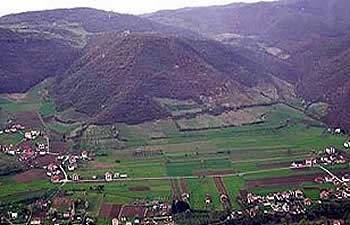 Photo: www.superbosna.com
It does resemble a pyramid:
 Photo: www.superbosna.com
Sunday, 4 June 2006
Yucca will show them
For some inexplicable reason, none of the plants I've ever bought managed to stay alive for more than a few weeks. Sadness descends upon me whenever I remember a cute little bonsai I bought two years ago. I saw it in a garden centre and just had to have it. Within two weeks all of its tiny, dark green leaves turned brown. Another two weeks and all that was left of it was its miniature, leafless trunk. I thought it was going through a mini-autumn season of its own, supposing that bonsai trees, minuscule as they are, must have a different notion of time. Much like cats or dogs. I expected it to enter a verdant spring of its own in no time. It never recovered though. I've kept the poor tree as a decoration of some sort (it does look quite nice, although a bit morbid, lifeless and denuded as it is). It now also serves as a caveat, reminding me to think twice before I buy a plant I know nothing about. I've been keeping that rule ever since.
Until yesterday, that is. I dragged a friend with me to that same garden centre, as a safeguard against impulsive shopping. The same friend who not only encouraged me to buy that bonsai two years ago, but also got one for himself (similarly unfortunate, as time would show). To cut a long story short, meet two new additions to my home: Yucca and Pachira. Described as low-maintenance plants, tolerating all sorts of conditions and asking for only a little bit of sunlight and water (TLC goes without saying), they seemed just perfect. I keep gazing at them as I write, checking obsessively for any sign of malaise or discontent. I've decided that these two are to prove everyone (myself included) wrong in thinking that I have a lethal effect on plants, as some have implied. I'm prepared to do anything it takes for them to live a long and healthy life. And if they survive until spring, I may even feel encouraged to do some serious container gardening next year. Fingers crossed!
Until yesterday, that is. I dragged a friend with me to that same garden centre, as a safeguard against impulsive shopping. The same friend who not only encouraged me to buy that bonsai two years ago, but also got one for himself (similarly unfortunate, as time would show). To cut a long story short, meet two new additions to my home: Yucca and Pachira. Described as low-maintenance plants, tolerating all sorts of conditions and asking for only a little bit of sunlight and water (TLC goes without saying), they seemed just perfect. I keep gazing at them as I write, checking obsessively for any sign of malaise or discontent. I've decided that these two are to prove everyone (myself included) wrong in thinking that I have a lethal effect on plants, as some have implied. I'm prepared to do anything it takes for them to live a long and healthy life. And if they survive until spring, I may even feel encouraged to do some serious container gardening next year. Fingers crossed!
Thursday, 27 April 2006
Yoga troubleshooter wanted
I was having really great time doing yoga this morning. Everything went just fine, I was centered and in sync with my inner self and all that - until I attempted to do this one:

A yoga torture posture from hell, as far as I'm concerned. I couldn't possibly lift my legs, head and chest simultaneously if my life depended on it.
This is what my handbook says about this asana: "The solar plexus area is revitalised and the massaging and stretching of the abdominal area relieves the sensations of anxiety we sometimes feel in the abdomen. [...] Toxins and tension are released from the organs helping them to work more effectively."
Well, those nasty toxins seem to have gone straight to my head, because I feel totally frustrated about not being able to pull it off, after months of practise. I know yoga is all about patience and slow progress, but for the love of...

A yoga torture posture from hell, as far as I'm concerned. I couldn't possibly lift my legs, head and chest simultaneously if my life depended on it.
This is what my handbook says about this asana: "The solar plexus area is revitalised and the massaging and stretching of the abdominal area relieves the sensations of anxiety we sometimes feel in the abdomen. [...] Toxins and tension are released from the organs helping them to work more effectively."
Well, those nasty toxins seem to have gone straight to my head, because I feel totally frustrated about not being able to pull it off, after months of practise. I know yoga is all about patience and slow progress, but for the love of...
Tuesday, 25 April 2006
This guy can't be an evangelical!
"An evangelical Virginia farmer says a revolution against industrial agriculture is just down the road. [...]
"Joel, who describes himself as a “Christian-libertarian-environmentalist-lunatic farmer,” speaks of his farming as his “ministry,” and certainly his 1,000 or so regular customers hear plenty of preaching. Each spring he sends out a long, feisty, single-spaced letter that could convince even a fast-food junkie that buying a pastured broiler from Polyface Farm qualifies as an act of social, environmental, nutritional, and political redemption."
READ THE REST OF THE ARTICLE AT MOTHER JONES:
http://www.motherjones.com/news/feature/2006/05/no_bar_code.html
"Joel, who describes himself as a “Christian-libertarian-environmentalist-lunatic farmer,” speaks of his farming as his “ministry,” and certainly his 1,000 or so regular customers hear plenty of preaching. Each spring he sends out a long, feisty, single-spaced letter that could convince even a fast-food junkie that buying a pastured broiler from Polyface Farm qualifies as an act of social, environmental, nutritional, and political redemption."
READ THE REST OF THE ARTICLE AT MOTHER JONES:
http://www.motherjones.com/news/feature/2006/05/no_bar_code.html
Wednesday, 5 April 2006
Dalmatia Revisited
Adriatic coast of Croatia has become popular again, after the civil war and unrest of the 1990s. Its beaches, islands and delightful towns testify to the truthfulness of the Croatian Tourist Board’s official motto: “The Mediterranean as it once was.” It didn’t take me much persuading to pay a visit, for the first time since the late 1980s.
I decided to travel by bus, for a number of reasons. The bus fare was quite cheap and so a great saver. Since the roads in Croatia are well maintained, the twelve-hour journey from Belgrade didn’t seem so long or tiresome at all. Each stop along the way proved to be a small adventure in itself, showing that Croatia’s rich cultural diversity doesn’t all come down to familiar, as-seen-on-TV, sights of Dubrovnik.
I left Belgrade on a hot July afternoon, reaching Serbian-Croatian border by midnight, amid old, tall trees of Sipovacka Forest of the country's continental, northeastern region. Several hours later, having quickly passed by Zagreb, the nation’s capital, we reached Lika, the region connecting continental and maritime parts of the country. Another short stop in one of its small towns, amidst white karst and cool air smelling of mountain herbs – and sheep! Adorably rustic.
After two more hours of wonderful scenery I got off the bus to Split, in the middle of Dalmatian nowhere. Below me, down the rocky hills, the so-called Karin Sea - actually a small bay of sorts, situated not far from Dalmatia’s highest mountain, Velebit. An unlikely tourist destination, with population of only several hundred (climbing up to several thousand during summer months). Karin certainly has its treasures: pristine nature, fine local wines, medieval Franciscan cloister and ancient monuments along the roads, dedicated to local pagan deities of many centuries ago.
Off the beaten path, it’s a Mediterranean pastoral idyll if there ever was one.
I decided to travel by bus, for a number of reasons. The bus fare was quite cheap and so a great saver. Since the roads in Croatia are well maintained, the twelve-hour journey from Belgrade didn’t seem so long or tiresome at all. Each stop along the way proved to be a small adventure in itself, showing that Croatia’s rich cultural diversity doesn’t all come down to familiar, as-seen-on-TV, sights of Dubrovnik.
I left Belgrade on a hot July afternoon, reaching Serbian-Croatian border by midnight, amid old, tall trees of Sipovacka Forest of the country's continental, northeastern region. Several hours later, having quickly passed by Zagreb, the nation’s capital, we reached Lika, the region connecting continental and maritime parts of the country. Another short stop in one of its small towns, amidst white karst and cool air smelling of mountain herbs – and sheep! Adorably rustic.
After two more hours of wonderful scenery I got off the bus to Split, in the middle of Dalmatian nowhere. Below me, down the rocky hills, the so-called Karin Sea - actually a small bay of sorts, situated not far from Dalmatia’s highest mountain, Velebit. An unlikely tourist destination, with population of only several hundred (climbing up to several thousand during summer months). Karin certainly has its treasures: pristine nature, fine local wines, medieval Franciscan cloister and ancient monuments along the roads, dedicated to local pagan deities of many centuries ago.
Off the beaten path, it’s a Mediterranean pastoral idyll if there ever was one.
Subscribe to:
Posts (Atom)